Self as a Spectrum: Moving Beyond the “In Self” or “Not in Self” Idea in IFS Therapy

One of the most useful ways to understand the Self in Internal Family Systems (IFS) is to stop considering it as an all or nothing state.
When you start to learn about the IFS model, it is very common for clients to have the question, “Am I in Self?”, or for clinicians learning the model to ask, "Does my client have enough access to Self?" For both clients and therapists, this can unintentionally turn Self into a magical destination, and turn on assessing/checking parts as to whether we or our clients are calm, curious, or compassionate enough. A part can even become invested in "getting into Self" (whatever that means).

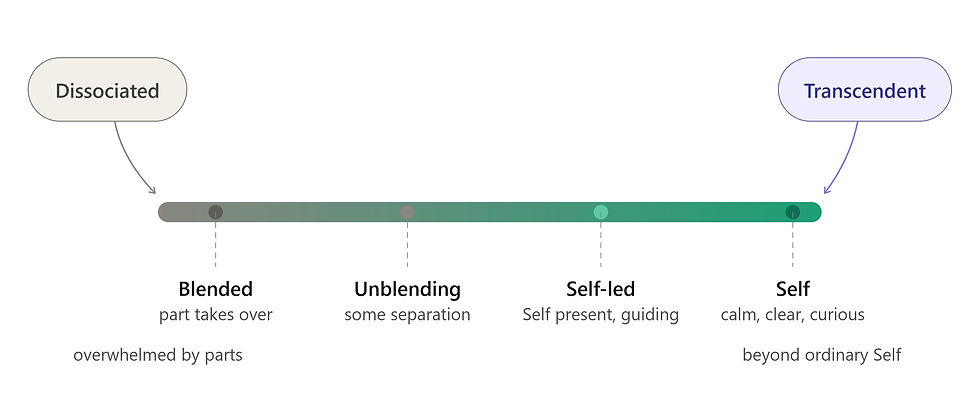
IFS Trainer, Cece Sykes offers a more nuanced way of understanding this through what she calls the Self Spectrum. Sykes developed the spectrum as a teaching tool to help clinicians and clients recognise that access to Self energy can vary considerably. Rather than being either in Self or out of Self, we can experience different degrees of access to Self at different moments.
From blended to Self-led in the Self Spectrum
At one end of the spectrum, a part may be completely blended. We can feel completed identified with that part, as though we are the anger, shame, fear, urgency or despair. There is little psychological distance between the Self and the part.
As some unblending occurs, there may be a small amount of space:
“A part of me is terrified.”
“Something in me really wants to get away.”
That small shift can make a difference because while we have not necessarily arrived at some perfect state of Self, we simply have more access to those Self qualities.
Further along the spectrum, a person may become increasingly Self-led. They can remain connected to the part while also relating to it from greater curiosity, compassion, clarity and perspective. I've written elsewhere about the familiar 8Cs of Self which describe qualities associated with Self energy, while the 5Ps add dimensions such as presence, patience, perspective, persistence and playfulness. The important point is that these qualities are not a test we have to pass in order to have access to some Self-energy.
Self can appear momentarily
Despite what expectations clients and therapists might hold, it is important to emphasise that nobody (not even the Dalai Lama) walks around in 100% Self energy all of the time. Sykes rightly describes therapists as becoming not only “parts detectors” but also “Self detectors”, listening for moments when Self energy becomes possible or available.
This is particularly important in trauma work. A client may spend much of a session overwhelmed by protective parts and then suddenly experience five seconds of curiosity toward one of them. Pausing the client in that moment matters enormously because a person who normally dissociates may notice what is happening inside for the first time, or someone dominated by shaming parts may briefly experience compassion inside. These are moments where the therapist can pause the client and invite them to notice the Self-energy.
Sykes' spectrum gives us a way of noticing these glimpses of Self rather than measuring therapy against an idealised state of permanent Self leadership. The Self spectrum is useful for recognising these small shifts and gradual increases in access to Self-energy.
Self is not about becoming perfectly calm
There is another important implication. Self does not necessarily look the same in every person. Sykes has cautioned against turning the 8 Cs into a rigid template for what Self must look like. A person can have considerable Self energy while feeling grief, anger, determination or taking a strong stand against injustice.
So perhaps the more useful question is not: “Am I in Self?”
but:
“How much access to Self do I have right now?”
And perhaps even more importantly: “Can I notice the difference?”
Because in IFS, even noticing is itself movement toward increased Self-energy.
Self is not a switch that is either on or off, but an ever available dimension of our experience, with our access to it changing from moment to moment, relationship to relationship and sometimes across an entire lifetime.
The power of the Self Spectrum gives us permission to stop chasing Self as a destination, and start recognising the moments when Self is already present.
About the Author
Sean Cuthbert is a Clinical Psychologist, Psychology Board of Australia (PBA) Approved Supervisor, Certified IFS Therapist, and IFS-I Approved Clinical Consultant in private practice in Melbourne, online throughout Australia, and internationally. He provides 1:1 therapy for clients, and supports professionals through individual and group supervision/consultation.


